From Minoan wine presses to organic family estates, discover the ancient story and vibrant present of Cretan wine, one of the Mediterranean's most compelling regions.
The island has been doing this for longer than almost anywhere else on earth, and that continuity shapes the soil, the varieties, and the people who tend them.
The story begins with the Minoans. Evidence of viticulture reaches back to at least 5,000 BCE, and the oldest wine press ever found, near Archanes, has been dated to around 1,580 BCE. Amphorae bearing Cretan markings have turned up in excavations across the entire Mediterranean basin, suggesting these wines were exported widely, centuries before any European wine trade we would recognise today. Crete was not simply producing wine. It was shaping how wine moved through the ancient world.
That foundation never disappeared. Through Byzantine occupation, Venetian rule (when Cretan wine was prized across Europe under the name Malmsey), and the Ottoman era, the vines remained. But for much of the twentieth century, production prioritised quantity over character. The real turning point came in 2006, when sixteen wineries chose to organise together around a single conviction: that the island's indigenous grape varieties were worth fighting for rather than replacing with easier-to-sell international names. That coalition doubled in size within a few years, and the result is a Crete now understood as one of the Mediterranean's most distinctive wine regions.
The grapes are the heart of it.
On the white side, Vidiano has emerged as the variety that most excites the wider wine world. Indigenous to the Rethymno and Heraklion regions, it produces wines of notable aromatic richness, with peach and apricot character alongside a creamy texture that holds up well in bottle. It had nearly disappeared by the late twentieth century; its rescue and subsequent prominence is a story repeated across Crete, where preserving rare local varieties has become something close to a cultural mission.
Vilana is the island's most widely planted white, offering floral and citrus notes with the freshness that earns its place at a taverna table in the summer heat. Malvasia, known here as Malvasia Bianca di Candia, carries intense fruit with a muscat-like finish; though it appears across the Mediterranean, most ampelographers believe it originated on Crete. Dafni and Plyto are rarer still, two ancient whites saved from extinction by producers including Lyrarakis.
Among the reds, Liatiko is one of the oldest varieties in Greece: soft in colour, delicate in structure, aromatic with dried fruit, herbs and flowers. Some critics draw comparisons with Pinot Noir, not in flavour but in the transparency good examples carry. Kotsifali is fuller and higher in alcohol, frequently blended with Mandilaria, which contributes the deep colour and tannic structure Kotsifali lacks on its own. That pairing is the foundation of the Archanes and Peza PDOs. Romeiko, found mostly in Chania, rounds out a cast of indigenous reds that reward patience.
The PDO system formalises this into four protected zones. Peza, just south of Heraklion, is the largest, producing around seventy percent of all PDO Cretan wine. Archanes sits at higher altitude (300 to 450 metres) and holds some of Greece's oldest cooperative winery infrastructure, with roots in 1933. Dafnes, at the edge of Psiloritis mountain, is devoted entirely to Liatiko. Sitia, in the far east, applies the strictest rules: whites must carry at least seventy percent Vilana, reds at least eighty percent Liatiko. Its remoteness and elevation give it a rawer character that many find compelling for precisely that reason. Beyond the PDOs, Chania, Rethymno, and Kissamos produce wines under the broader PGI Crete designation, where the rules are looser and producers experiment more freely.
Several estates have helped define what this new era looks and tastes like.
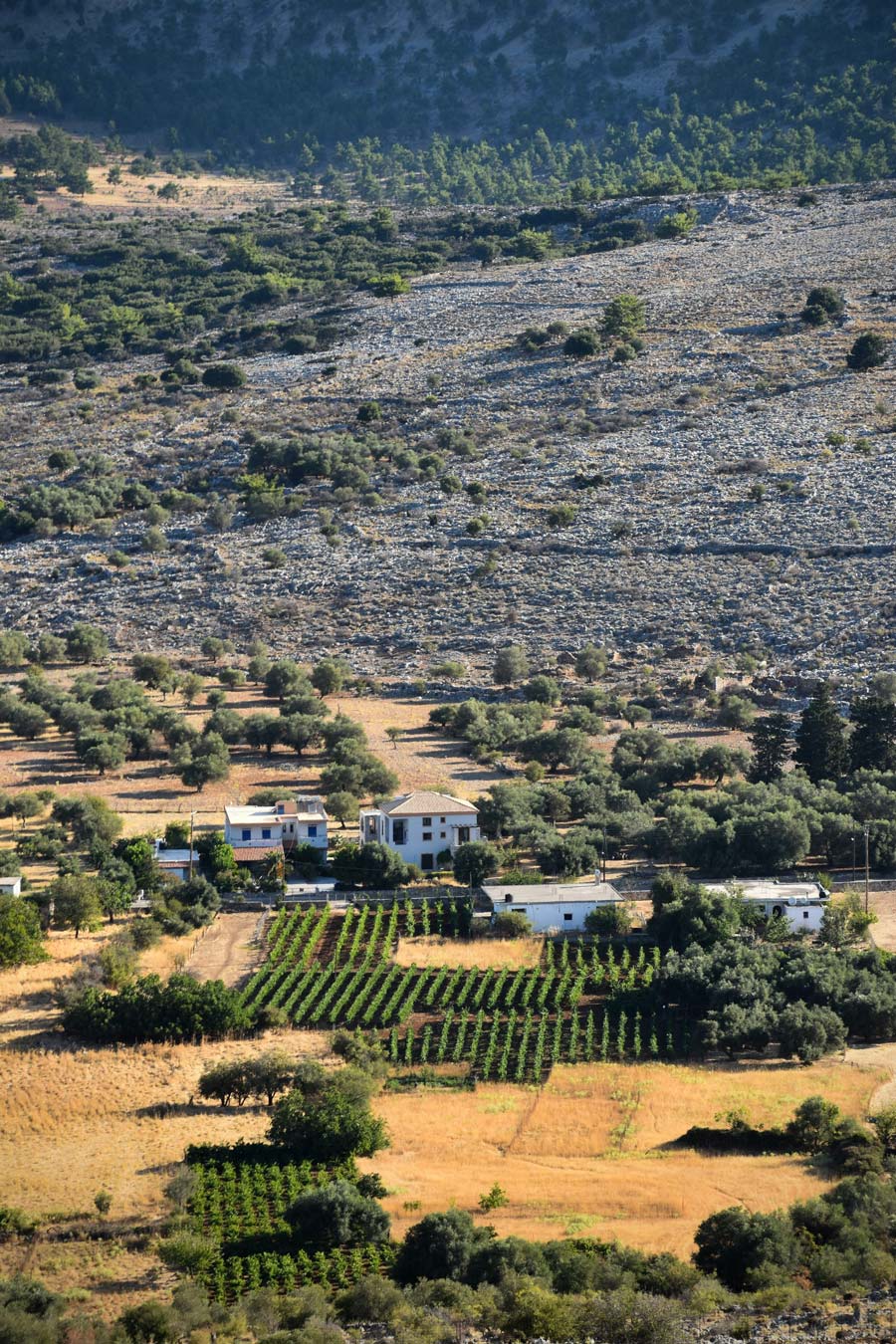
Above: A small vineyard in the Cretan highlands. Photo by Arno Senoner on Unsplash
Lyrarakis, founded in 1966 in the Peza area, is the winery most associated with the revival of rare indigenous varieties. The family rescued Plyto and Dafni from near-extinction, and their site in Alagni, where tasting is done under a pergola with mountain views and small plates of local produce, has earned a reputation as one of the most welcoming wine experiences on the island.
Domaine Paterianakis, also in Peza, was among the first estates in Crete to farm organically. The property overlooks low rolling hills toward the Cretan Sea, built from stone sourced on-site. The bees on its labels are not decorative: they reflect a farming philosophy centred on soil health and minimal intervention. Bees held sacred status in Minoan culture too.
Karavitakis, a family estate near Chania established in 1998, represents the more outward-looking side of Cretan production. Father Manolis championed Vidiano when it was still obscure; his son Nikos now produces it across a range of styles, from light and immediate to skin-contact versions that sit comfortably in the natural wine conversation.
Douloufakis, in the Dafnes region with roots in the late nineteenth century, produces both indigenous and international varieties at around 350 metres. The estate's dry Liatiko was long a departure from convention, the variety having been traditionally reserved for sweet wine. Douloufakis showed it could produce structured, fragrant dry reds of real distinction.
Manousakis Winery, in the foothills of the White Mountains near Vatolakkos, focuses on organic and biodynamic viticulture at altitude. The result is wines shaped by mountain breezes, significant day-to-night temperature swings, and low intervention.
Toplou Monastery in the far east, founded in the fifteenth century, has produced sacramental wine since the Middle Ages. Its winery operates today with a respect for traditional methods and ecological principles, making it one of the oldest continuously active producers on an island where continuity is already the defining characteristic.
The broader shift over the last two decades has been toward organic and biodynamic farming, and it is not simply a marketing posture. The island's hot, dry growing season naturally reduces the disease pressure that forces chemical intervention in cooler regions. Several estates have taken this opportunity further: grazing animals between vine rows, maintaining ground cover to fix nitrogen, working biodynamic preparations into the soil. The result, at the better estates, is vineyards that look genuinely alive, thick grass and wildflowers competing with vines for the same thin, rocky limestone soils that push roots deep and concentrate flavour.
International varieties have a role too. Syrah, Cabernet Sauvignon, Viognier, and others are planted across the island, and several estates blend them thoughtfully with indigenous grapes. But the producers commanding the most international attention are, almost without exception, the ones most committed to Crete's own varieties.
The island does not need to compete with the established styles of France or Italy. It has Vidiano, Liatiko, Kotsifali, Malvasia, Plyto, Dafni, shaped by soils and sun and sea air that have been producing wine since before written history. The glass you pour at a terrace overlooking the Aegean may have come from vines growing in the same hillside soil as the amphora fragments archaeologists are still turning up a few kilometres away.
That is not a bad thing to think about while the sun sets.


